
Thưa các quý vị và các bạn!
Ngày 28 và 29 tháng Mười Hai 2019, Hội Khoa học Lịch sử thành phố Đà Nẵng đã tổ chức hội thảo khoa học với chủ đề ‘100 năm chữ Quốc ngữ ở Việt Nam‘.
Ban Tổ chức Hội thảo đã trân trọng mời ông Nguyễn Lân Bình, nhân danh là Chủ nhiệm trang tin chuyên đề về học giả Nguyễn Văn Vĩnh, người Việt Nam đã trọn đời cống hiến tất cả sức lực và trí tuệ cho sự phát triển của chữ Quốc ngữ. BBT chúng tôi xin trân trọng giới thiệu với các quý vị và các bạn, toàn văn bản tham luận do ông Nguyễn Lân Bình trình bày tại Hội thảo.
Bản tham luận này cũng được in trong kỷ yếu của Hội thảo, đồng thời BBT chúng tôi đã nhờ cộng sự chuyển ngữ sang tiếng Anh. Do đề tài về sự nghiệp học giả Nguyễn Văn Vĩnh cực kỳ đồ sộ, với nhiều cứ liệu lịch sử phức tạp và đa dạng, cộng với năng lực có hạn và thời gian gấp gáp, nên chất lượng chuyển ngữ chưa thỏa mãn được những yêu cầu khắt khe của một văn bản dịch thuật. Tuy nhiên, để thuận lợi cho các độc giả là người Việt ở xa quê hương, ít dùng tiếng mẹ đẻ cũng có thể cảm nhận được nội dung đặc biệt này, nên BBT chúng tôi vẫn xin được mạnh dạn giới thiệu bản tiếng Anh. Nếu có thiếu sót, xin các quý vị và các bạn độ lượng khi đánh giá, và chia sẻ với chúng tôi nếu có thể.Biết ơn Tạo hóa, Trời, Phật và các Thánh thần, đây là công việc cuối cùng, kết thúc một năm lao động của chúng tôi, năm 2019. Xin được chân thành cảm ơn sự quan tâm của các quý vị và các bạn trong năm qua đối với trang tin Tannamtu.com!
Xin được hẹn các quý vị và các bạn vào năm 2020 với nhiều thông tin hữu ích và ý nghĩa hơn, liên quan đến nội dung trang tin.Kính chúc các quý vị và các bạn đón năm mới vui vẻ, khỏe mạnh!
Trân trọng!
Nguyễn Văn Vĩnh and his Lifelong Ideal of Propagation
of the quốc ngữ in Early 20th Century
Nguyễn Lân Bình
1. Situation of the quốc ngữ in early 19th century
Western missionaries who embarked in Đại Việt (Việt Nam) in the 17th century (circa 1620) found a discrepancy between local language and the borrowed Chinese writing. They decided to an alphabet based on Latin script to create a new language, called the quốc ngữ. Their intial purpose was to make easy their evangelical work.
This new language has improved gradually ever since, mainly through its use in Catholic communities.
Two hundred years from the birth of the quốc ngữ when the French set foot in the southern region of Việt Nam, or Đàng Trong (Cochichina), in 1858, they found it difficult to set up an effective administrative system using French language and Chinese ideogram and Vietnamese ideogram alternately (chữ nôm).
In such a situation at the time, Trương Vĩnh Ký, or Pestrus Ký born in 1837 by his Christian name, appeared as a great cultural personage in Vietnamese history. He was the first Vietnamese who contributed to the creation of the first official newspaper published in quốc ngữ in Cochichina which had the statute of direct French colonial administration as contrasted with the protectorates of the centre (Anam) and north Việt Nam (Tonkin).
The birth of the new literature in quốc ngữ in the form of this public journal in Cochichina was a new conception to the Centre and the North still dominated by Confucian education and the Chinese ideogram.
Pétrus Ký has left to us 118 works. His publications were important contribution to the history of the literature in quốc ngữ. Some well-known works: Petit Cours d’histoire d’Anam (1875, 1877; Handbook of History of Anam); Truyện đất Nam Kỳ lịch sử Đàng trong (Handbook of the Geography of Lower Cochinchina), and Đại Nam Việt quốc triều sử ký (1897; History of Dynasties of Great Việt).
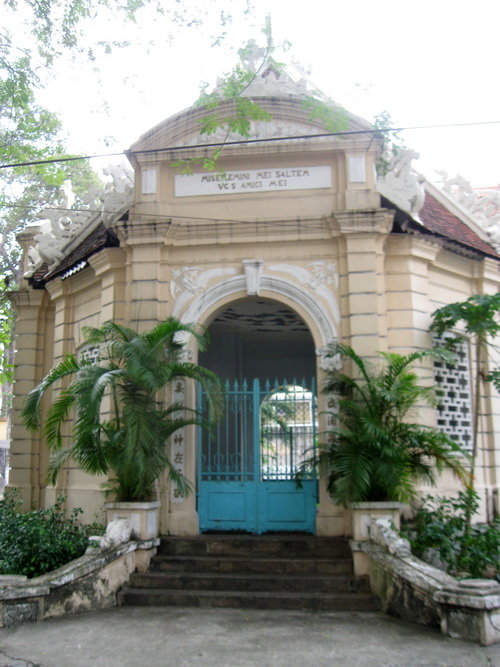
Ký’s indefatigable efforts in the propagation of the quốc ngữ evoked a controversy which has not yet ended. Today visitors to his sepulchre at 520 Trần Hưng Đạo, district 5, Hồ Chí Minh City might ask themselves the meaning of a phrase carved in Latin: “Miseremini mei saltem vos acimic mei” (Have mercy on me, at least my friends)
It was regrettable that his efforts in the popularization of the quốc ngữ has not yet found today widespread recognition fully as it might be as the way to escape from the recurrent danger of the sinonization.
We cannot help feel some bitter complaining that he alluded to in his autobiological poem in extremis titled Cuốn sổ bình sanh, The Book of my Life:
… Am I just a book-worm?/ All end up in a coffin?
And by using a classical Chinese reference he compared himself to a man serving the dynasty Tần but his heart still subject to missing the dynasty Hán.
This irony of fate was associated with a historical period of the nation as a whole!
The direct rule of the French in Cochichina led to imposition of the quốc ngữ as an administrative language.
In 1869, admiral Marie Gustave Hector Ohier signed a decree to promulgate the use of the quốc ngữ in offcicial documents aiming at replacing gradually the Chinese ideogram. The Decree 82, signed in 6th April 1878 by Governor Lafont to offcially stipulating the quốc ngữ as the only and official language in transaction in writing, with the entry into effect from 1882.[1]
Such an imposition was not a natural process to bring fort a social change of the writing system. The quốc ngữ did not spread, proliferated. It did not progated into the centre of Việt Nam still under the nominal authority of the Huế Court to say nothing of the far Tonkin.
Newspapers and publications printed in quốc ngữ did not appear until late 19 century!
2. Tonkin in the beginning of the 20th Century and Nguyễn Văn Vĩnh
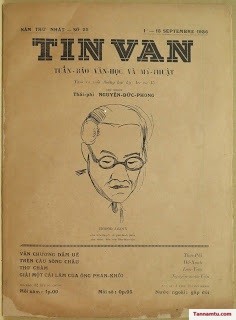
Thái Phỉ (Nguyễn Đức Phong), director Tin Văn (Literary News) had an interview in 28th July 1935 with Nguyễn Văn Vĩnh as foundator of the first newspaper in quốc ngữ in Tonkin (1907). This interview was published in a series of 9 numbers in Tin Văn.
Nguyễn Văn Vĩnh tâm confided:
“I am mainly an autodidact. But, I have to acknowledge that my old teacher of Chinese ideogram, Phan-hữu-Đại, has exerced much influence on me. Honestly speaking, he is a Vietnamese sage …
… Many Confucian scholars, his contemporaries, I have to emphasize this, have started to read books they called “new books”, of Khang hữu Vi, Lương Khải Siêu, for example, and they were already influenced with certain ideas associated with popular rights. Old Phan hữu-Đại has had his own ideas. I have shared with him certain ideas when I began my career in journalism. But he liked to read French history and prefered Vietnamese translations.
To please him, I chose a French book about History, translated it and read for him. The idea of translating Western books occurred to my mind since. But, long before that day, when I was 17 or 18 years old, with an encouragement of my colleague, Mr. Nguyễn Dực Văn, a petty clerk in the provincial administration of Bắc Ninh, I already dared to translate Rousseau’s “Contrat social” and Montesquieu’ s “Esprit de loi”. He had read these books translated in Chinese so he made a confrontation of the two translations. We browsed two translations and discussed if some things was found which we were not sure which translation was correct. I gained a critical mind. After that I began to translate the first volume of “Traité de l’Esprit” by Helvétius. It was in 1905, I think”.[2]
Nguyễn Văn Vĩnh began his career of interpretation at 15 years of age in Lao Cai in 1897, then he moved to Hải Phòng (1898 – 1903). During the periods he worked in these provincial and municipal administration he had a chance to familiarize with French culture.
In this culture milieu he had opportunity to read French authors and gained knowlegde, by self-teaching, about advanced ideas of philosophy, science, and culture such as human rights, freedom of press.
It was not without reason that in 1907 the well-known patriot Phan Châu Trinh (1872 – 1926) came to see Nguyễn Văn Vĩnh at his house at 39 Mã Mây, Hà Nội, in order to express in person his admiration and recognition toward Nguyễn Văn Vĩnh for his translation of the Petition for social reform, written in Chinese ideogram by Phan Bội Châu, into French language (Lettre de Phan Chu Trinh au gouverneur général en 1906: Letter of Phan Chau Trinh to the Governor-General).
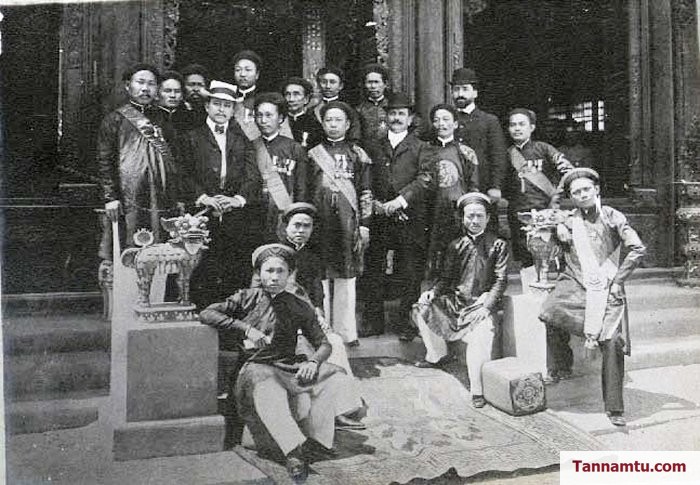
Nguyễn Văn Vĩnh was sent to Marseille in 1906 in the framework of the Colonial Exposition. He made for the first time contact with the press and printing industry. This personal experience prompted him, as a twist of fate, to turn to the road of the press and cultural activities.
Nguyễn Văn Vĩnh focused on the quốc ngữ as a vehicle of transmission of knowledge, and as a tool to enlighten the people and nurture the nation’s vital force. Nguyễn Văn Vĩnh lamented on the situation of the use of quốc ngữ:
“The quốc ngữ was ackowledged as official administrative language since long time, [Admiral Marie Gustave Hector Ohier signed a decree in 1869], but it was almost abandoned. Because many Confucian scholars were never curing themselves of the nostalgia of the aged-old tradition of the Chinese classical characters …They defensed the Chinese ideograms and praised its linguistic power. But I think linguistic power resides in its exxploitation and usage… And there are also people who have had the cult of Confucianism, so they have good reason to saveguard the Chinese ideogram. But it would be much better if the common people could read texts translated into quốc ngữ; otherwise had only learned people who know the Chinese ideograms could read Chinese ideograms”.[3]
Nguyễn Văn Vĩnh saw opportunities of the press as the best way to promote the quốc ngữ. He shared his bold ideas with his close friend Phạm Duy Tốn in one letter from Marseille ngày dated June 27, 1906 that he would devote to social reform through the propagation of the quốc ngữ by way of the press:
“… we Vietnamese are very obstinate. It is not easy to raise the level of their culture. We are not willing to acknowdge that our nation is far inferior to other peoples. Anyway, acknowledge one’s weakness is not a shame! … It would be a great pleasure to think that I will be the first man who will do this. My parents, my family, all must fade out to leave room to this most wonderful idea…”[4]
3. Nguyễn Văn Vĩnh and his cultural Activities
Late in 1906, Nguyễn Văn Vĩnh came back from France. He was firmly believed that the press would be the most efficient means, and an interesting means, to demonstrate to the people how easy to learn the new national language based on Latin alphabet!
He understood their condition under which they had to live under an administrative system of the protectorate with nominal authority of a feodal court.
To help them realize this by way of the values of progressive theories brought in the country by their oppressors. Vietnamese people had to master their own language.
He chose a different way from many other revolutionaries of the time who were upholding the banner of political reforms, but, ironically, such exhortations were written in Chinese ideograms!
His strategy was also different. It was a peaceful and cultural struggle as contrasted with many rightist revolutionaries who had violent options or armed struggle.
Nguyễn Văn Vĩnh, umbued with the ideas of the French Revolution, understood its radicalism. He wrote a book in quốc ngữ to exhort cultural and political awareness, which titled “VIETNAMESE PEOPLE’S MEANS and POPULAR RIGHTS” – “ A people do know their rights will lead undignified life ”.[5]

But what can he do without the quốc ngữ and the press?!
He had to suffer murmur in his ears and contemps on the part of those who benefited from the system. They derided: Vietnamese language based on Latin alphabet is a product of foreign aggressors …!
Nguyễn Văn Vĩnh, like Phan Châu Trinh, understood very well the masses and their inertia, their weak-mindedness, and self-interest. They affimed that learning the quốc ngữ would be best suited to a poverty-stricken people.
In the preface to Tam quốc chí diễn nghĩa (Three Kindoms), which he co-translated with Phan Kế Bính (1875 – 1921) from Chinese ideograms into quốc ngữ, published in 1909 in Hà Nội, he praised the quốc ngữ in these terms:
“That happiness, that good omen for the destiny of the posterior generations of Eternal Việt Nam depend on the quốc ngữ. What a beautiful alphabets! How easy to read! With 23 letters, 5 tones of our national language we can write as much as we wish …”.
He exhort people to learn the quốc ngữ in an issue dated March 28, 1907 of Đăng Cổ Tùng Báo:
“Just a few days for a smart person to learn, in one month in maximum for the slow-witted”.
He wrote:
“Any coutry called civilized has had a written language of its own. Civilization derives from this. Texts are mobile and can be moved to any reader in the country”.[6]
In 1907, Nguyễn Văn Vĩnh, aged 25, decided to resign from his post in the administration Office in Hanoi and devoted himself to a liberal career: journalism and publishing.
His ultimate goal was aiming at popularizing the quốc ngữ, raising the level of knowledge, and changing the destiny of the whole nation.
He denounced monarchic ideology of the rule of man “suzerain-people” (Vua – Tôi)![7]
Nguyễn Văn Vĩnh established the first printery in Hà Nội. Starting from nought, and in a country under colonial rule, he had to cooperate with François Henry Schneider(1831 – 1929), a French of Germain origin. Schneider was an expert in printing and publishing. He had been in Cochichina since 1882 and had obtained contracts signed with French Navy.
Schneiderhadalso cooperated with Trương Vĩnh Ký and Huỳnh Tịnh Của (1830 – 1908), on a personal basis though, but their cooperation failed. Until Schneider met Nguyễn Văn Vĩnh he had to renew the signed contract six times.
In the quality of a an advocate of the “new books” (exposure to Chinese reformist literature), Nguyễn Văn Vĩnh had relationship, before and after the birth of Đông Kinh Nghĩa Thục (1907), School of the East Capital for the Just Cause (Free School), with many great reformist scholars such as Phan Kế Bính, Dương Bá Trạc (1884 – 1944), Nguyễn Đỗ Mục (1882 – 1951), Hoàng Tăng Bí (1883 – 1939), Phạm Duy Tốn (1881 – 1924), and Trần Trọng Kim (1883 – 1953).
Nguyễn Văn Vĩnh established Đăng Cổ Tùng Báo, the first periodical in Tonkin in 1907 in connection with a call for social reform from patriotic scholars in combination with a demand for a reform of the educational system as insisted on by the Governor-General Paul Beau (1857 – 1927).
The periodical was an efficient means of communication. It was as if a cultural vehicle beneffiting both sides. Schneider needed to finalize the contract his had signed and Nguyễn Văn Vĩnh wanted to popularize the new writing language to his compatriots. He only contribution was intellectual and all his devotion to the culture.
He saw the periodical as an opportunity to call for and exhort the usage and perfection of the quốc ngữ. He acted without self-interest, with all his idealistic (see The Anamite must write in Anamite’s language: Người Annam nên viết chữ Annam[8].
School of the East Capital for the Just Cause, Đông Kinh Nghĩa Thục, was a school welcoming the general population. Nguyễn Văn Vĩnh believed that the new writing language would some day attractive enough to replace gradually the Chinese ideograms without recourse to legal imposition.
But, ironically, this turned out to be a pretext for the conservatist to brand Nguyễn Văn Vĩnh’s exxhortation of the quốc ngữ as cause of the disruption of the cultural trandition of the Hán ideograms and the Nôm.
4. Nguyễn Văn Vĩnh’s Strategy of the Popularization of the quốc ngữ
Nguyễn Văn Vĩnh set up a long-term strategy. He was the first to bring in the concept of the press in Việt Nam. His strategy was set out in Đăng Cổ Tùng Báo (1907) inclduding:
- This newspaper will publish articles in vietnamese language, focusing on the modernization in all fields: culture, education, commerce, politics, sciences. It will use a simple and plain writing style with a view to heightening the cultural standard of the people (khai dân trí).
2. This newspaper will act as an organ of public speech of School of the East Capital for the Just Cause (Free School), focusing on top social issues and reformist ideas of some prominents scholars. The French quickly grew suspicious the School’s syllabus and the eruption of this movement of the strengthening of the people’s spirit (chấn dân khí)
3. To point out the demand by the people for the French to change their policies and through translations of western books to promoting westernized education and increase the people’s level of standard living (hậu dân sinh).
4. Publish administrative notices and regulations as promulgated by the French, including regulations regarding the press and publishing activities.
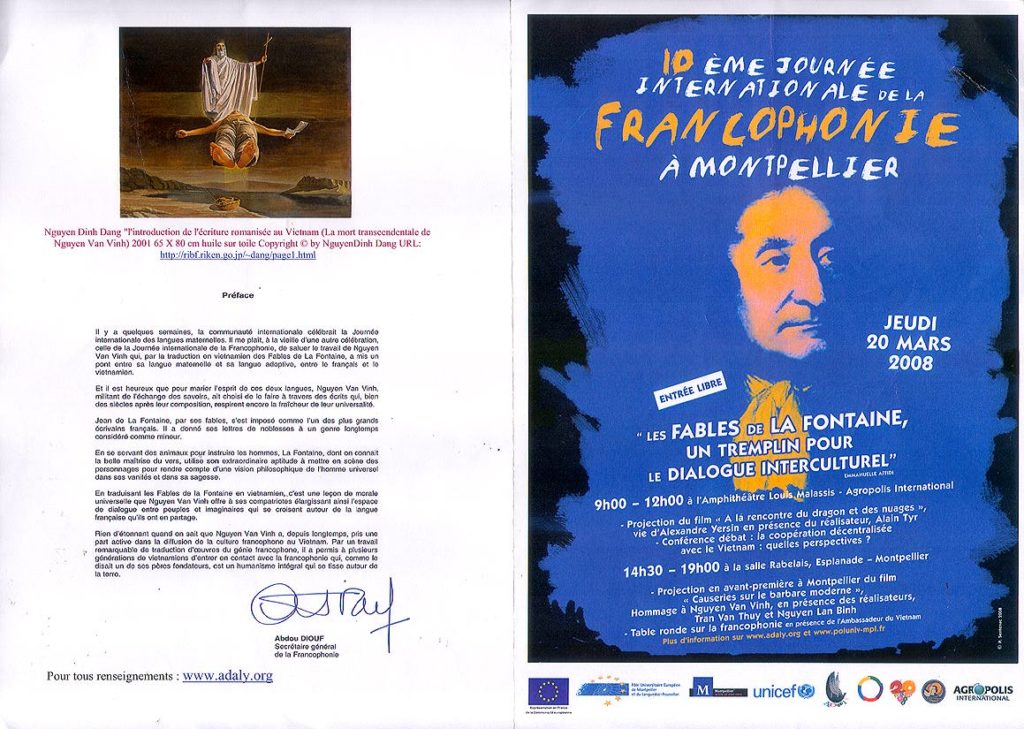
5. Publish translations of French literature (La Fontaine’s Fables…). To act as “a bridge between French culture and Vietnamese culture”.[9]
But, Nguyễn Văn Vĩnh aimed at much higher goal. He wanted to exploit the capacity of the national language to write prose, paving the foundation for the formation of the New Poem (Thơ Mới) and the literature in quốc ngữ, and in the same time to introduce and summarize western literature to suit to the mentality of the general population.
Đăng Cổ Tùng Báo was the first powerful step of the nascent literature in quốc ngữ. It promoted popular rights and the alternative to the use of vilolence in changing the society. No doubts, Đăng Cổ Tùng Báo deemed to be a threat to the colonial rule with nominal authority of a feudalistic court.
The Secretary-General of L’Association nationale de la progagation de la langue française (186 Blv. Saint Germain, Paris) said about the relationship of Phan Châu Trinh and Nguyễn Văn Vĩnh in his letter dated October 3, 1911 sent to Mr. the General Resident Paul Bertin Tonkin as follows (extrait):
“It was not a coincidence that both Phan Chu Trinh and Nguyễn Văn Vĩnh mentioned the Philippine revolutionary leader Aguinaldo in The Free School’s syllabus in 1907…”.
After the Free School had to close its doors suddenly, Đăng Cổ Tùng Báo, the first child of journalism in Tonkin and Anam had its licence to publish in Vietnamese be withdrawn in 1907.[10]
In 1908, Nguyễn Văn Vĩnh and F.H. Schneider found two journals in French, Notre Journal (Our Journal) and Notre Revue (Our Review). Nguyễn Văn Vĩnh presented, for the first time, in these journals the Perfume Pagoda (Chùa Hương) and The Tale of Kiều, one representative of the tangible culture and the other of intangible culture of Vietnamese people.
In 1911, F.H.Schneider sent Nguyễn Văn Vĩnh to Sài Gòn, possibly to assist Lục Tỉnh Tân Văn (New Literature of Six Provinces), the first journal in Vietnamese language which Schneider created in 1907.
Nguyễn Văn Vĩnh was un uncompromising man. He turned to translating activities. He chose to translate great works of the West. He saw this as a way to improve on Vietnamese language both in syntax and prosing principles.
In 1912, Nguyễn Văn Vĩnh requested to pay visit to The Ministry of Education Cao Xuân Dục (1843-1823) at Huế Court. This high-ranking of old trandition of Confician culture was hard to persuade of replacing Chinese ideograms by the quốc ngữ as offcial national language. Nguyễn Văn Vĩnh donated a copy of Cách học chữ quốc ngữ (How to learn quốc ngữ).
Nguyễn Văn Vĩnh was strongly moved when he heard that minister Cao Xuân Dục had delivered at speech written in quốc ngữ at the graduation ceremony of trường Quốc Tử Giám in Huế (The School for the Children of the Nation) on June 22, 1913 ngày 22/6/1913 (extrait):
“It is a great pleasure today for a minister of Education to deliver a speech in quốc ngữ at the greatest school of the country. It is as if a missionary on his preaching tour around the country has recruited on behalf of God a great and noble faithful”.[11]
During this period Tonkin and Anam saw serious events stirring violence. The most typical was the resurrection led by Phan Bội Châu.
Nguyễn Văn Vĩnh and Phan Châu Trinh, on the contrary, had advocated a non-violent path. They saw the drawing the people into violent struggle unjustified in the then context of Việt Nam. Phan Châu Trinh himself had witnessed the “Save King” movement crumbled in 1895 (Phong trào Cần Vương), said: “Vietnamese people already chose armed struggle against the French and it was harshly and bloodily repressed”.
Nguyễn Văn Vĩnh wished to follow a road of peaceful cultural renovation and modernization of knowledge.
The French administration had to realize thay illeteracy was a barrier to their rule. This prompted them to have allowed a journal in Vietnamese language be created in 1913: Đông Dương tạp chí (Indochina Journal). Their intention was to balancing social mentality.[12]
This journal was founded, on the spur of the situation, benefited both the ruler and the ruled. Nguyễn Văn Vĩnh had an opportunity once again to become director of Đông Dương tạp chí.
“… Đông Dương tạp chí has made considerable contributions to the popularization of the Quốc ngữ to the general population and the change in prosing and writing. The journal also propagated Western ideas through translations and studies of Oriental literature from a new spirit. Especially, the journal had made major contribution to the modernization of the literature in the first 30 years of the XX century…”.[13]
In 1917, Nguyễn Văn Vĩnh became the director of Trung Bắc Tân Văn (Anam and Tonkin New Literature), the first daily newspaper in Vietnamese language in the history of Vietanamese press and publishing[14]. Nguyễn Văn Vĩnh, in this newspaper, called for the learning of Western logical thinking, which was quite new to the Vietnamese people.
In 1919, Nguyễn Văn Vĩnh created Học Báo (Journal for Self-Learning) the first pedagogical journal in the history of Vietnamese press and publishing.
Also in 1919, The Nguyễn Court at Huế officially abolished the old system of mandarinal contests of “thi hội” (a triennal contest) and “thi đình” (the Court contest), paving the way for the modernized system of education using the Quốc ngữ.
To make something in lieu of a gift to himself, Nguyễn Văn Vĩnh has had made some furnitures and had nacre-carved on a pair of divan with texts drawn from La Fontaine’s Fables: The Wolf and the Stock and The Wolf and the Dog.
The divans belong to grand-children of Nguyễn Văn Vĩnh.

5. After 1919
Governor-General of Indochina Merlin signed a decree dated September 18, 1924 to officially stipulate the quốc ngữ be taught in primary schools in the whole country. Nguyễn Văn Vĩnh được sự hỗ trợ with the support of E. Vayrac (Chief of the Office of Indigenous Affairs) created in 1926 a center of publishing and propagation of reading culture, La pensée de l’Occident (The Thought of the West) in Hanoi.
During the time he worked in this center he made a list of 20 books and he would translate them in the next 20 years.
In 1927, Nguyễn Văn Vĩnh succeed in removating the quốc ngữ following the principle oo = ô, aa = â, ow = ơ… This renovation is still in use in telegraphics today.[15]
Nguyễn Văn Vĩnh was always committed to the ideal of democracy, freedom of press and equality. This was a reason why the French seemed to see that his activities were not benefitting the administration.
In 1930, ironically, after a long period the French failed to persuade or draw him to within the design of the administration, they withdrawed his licence to write in Quốc ngữ.
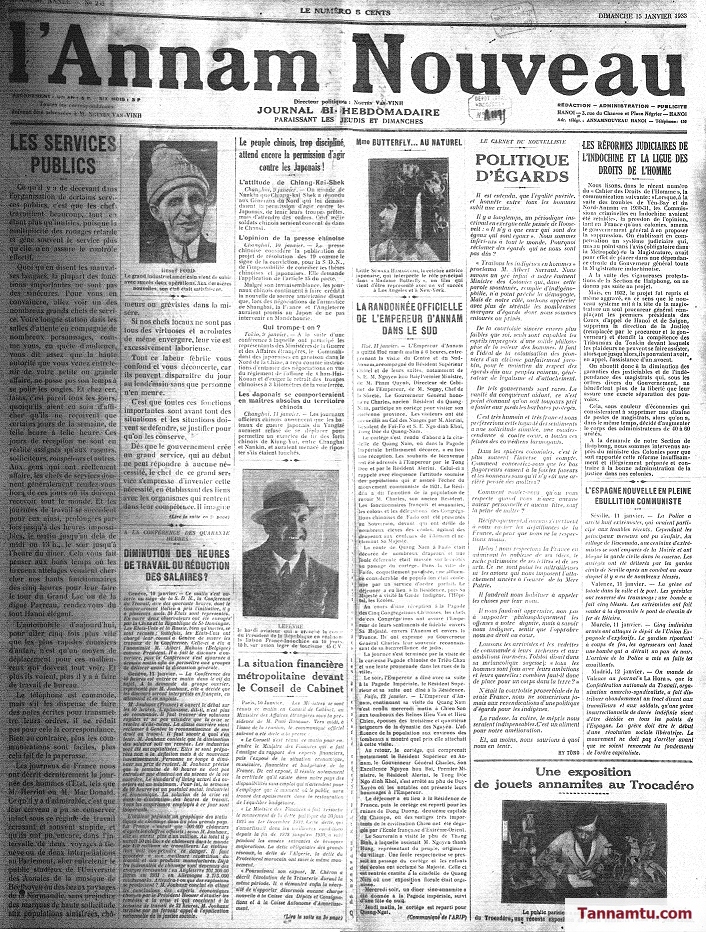
In1931, Nguyễn Văn Vĩnh decided to created a journal of his own. The journal was published in French, L’Annam Nouveau (Nước Nam mới). The first issue appeared on 21st January, 1931.
Although the journal was published in French and it was born out of a political conflict between Nguyễn Văn Vĩnh and the French, it had rublic reserved to the quốc ngữ.
In the issue Nr.100, dated 10/1/1932, Nguyễn Văn Vĩnh wrote an article: Pour un vocabulaire uniforme à l’usage des journaux indigènes (For an unified vocabulary for use in indigenous journal). From isssue 115 – 118, he had Chữ Quốc ngữ đổi mới (Le Quốc ngữ modifié: the renovated quốc ngữ). In issue 146 ò 24/6/1932, he had an article on standard use of Vietnamese language: Một số những lưu ý khi học tiếng An Nam (Notes pour un cours d’Annamite: Notes on a Course of Vietnamese Language.
The administration could not extinguish Vĩnh’s love for the Vietnamese language and the self-esteemof the Vietanmese race. He often called himself : WE THE RUSTIC PEOPLE …
Nguyễn Văn Vĩnh never said he was “something”!
L’Annam Nouveau was awarded Grand Prix at the International Fair of the Press in colonized countries in Paris in 1932.[16]
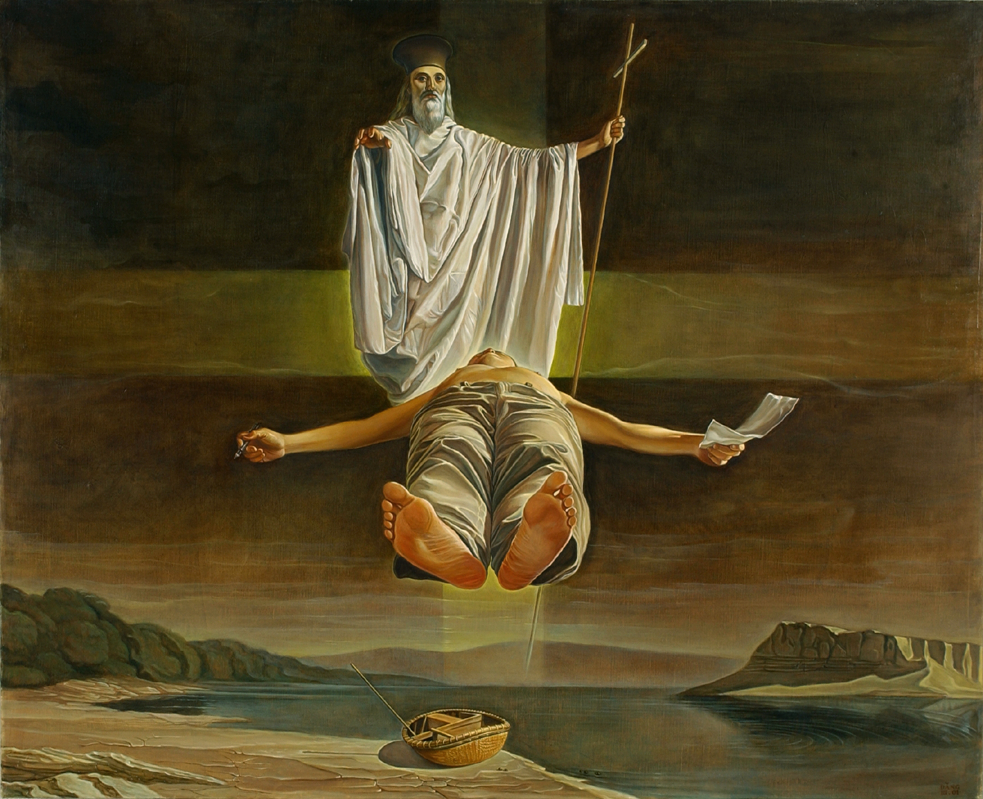
In 1930, the colonial administration had no patience with an excellent and patriotic student of French civilization. To break his pen, the French demanded him to pay a debt to Indochina Bank. His possessions were confiscated. He had to choose either to be in jail or to go to Laos to seek for gold to pay debt to Indochina Bank.
After more than one month in jungle and on one night he was found died, alone in a small boat on Sebanhieng River, during a violent storm still holding in his hand a fountain pen and a note-book … It was on May 1, 1936.
On 2/5/1936, the authorities made a public notice: Nguyễn Văn Vĩnh died of malaria fever and dysentery….!!!
Dear Participants!
I must acknowledge that I have no competent knowledge enough to judge the true merits of Nguyễn Văn Vĩnh to the quốc ngữ.
For us his Family, the legacy Nguyễn Văn Vĩnh left to the literature in quốc ngữ will be for the future of knowledge of the Vietnamese race and for the building of an advanced country, and the high level of intellectual development of the people.
With an retrospective review of the attitudes of the political regimes since the feudalistic court Nguyễn to the colonial administration to the State of the proletariat, with exception of the Republic of Vietnam in the South, one can see cruel and persistent stereotyped and biased judgements and evaluation of his merits and dismerits.
Nguyễn Văn Vĩnh refused to be conferred a golden medal by King Khải Định in1918, turned away from a proposal of nomination to be a minister in 1932 and refused to accept the award of la Légion d’Honeur of the French government in 1932, and ended up in a death with doubtful reason on Sebanhieng River in 1936. Nguyễn Văn Vĩnh is an idealistic man. At age of 24 he wrote in a letter dated June 27, 1906 from Marseille:
“… I rejoyce myself with the idea that I will the first man to do this in order to create a better future. My parents, my family, all must fade out to leave room to this most wonderful idea Cha mẹ, anh em, vợ con, tất cả đều phai nhòa trước tư tưởng đó để nhường chỗ cho một lòng vui thích êm ái nhất…”.
HISTORY will not turn its back to the merits, sacrifice of a man who worked in a dignified manner and not for fame or self-interest.
I would like to mention again some comments and evaluations of Nguyễn Văn Vĩnh in the past and today:
“Translating works of Victor Hugo, Alexandre Dumas, Lafontaine into other language is a difficult job. And would be almost unthinkable how a man can translate such works into Vietnamese language, a monosyllabic language and newly created and as yet undevelopped.
Nguyễn Văn Vĩnh has done such a wonderful job. He had to build up a writing language to replace gradually the Nôm which was considered to be a language of a Chinese minority..
Nguyễn Văn Vĩnh was really a linguistic “goldsmith”. A patient worker of language. He ginded, he polished, and made it flowery, glittering, and reflecting all colours of the sunshine ”.[17]
“We have to content ourselves with saying that he has written very much, both in Vietnamese and in French, about the need to unify and systemize the orthography, syntax in order to enhance its efficiency and effectiveness. He has promoted and exhorted the standardization of Vietnamese language in schools. He has wanted to find the origins and clear meaning of words, especially borrowed word from Chinese ideograms. He was very prudent when he wrote about pronunciation, transcription of sounds, and modifications applicable to translation from French and Chinese into Vietamese.
… He was an advocate early for learning of Vietnamese language by French people. According to Nguyễn Văn Vĩnh, education must be mutual, between one people an another, and must be a top priority in the plan to create an accord of the French and the Vietnamese, despite of the deep gap of races and ethnies, which he in fact experienced by himself”.[18]
“… Thus, his devotion to the development of the quốc ngữ alone will suffice to reveal all the worth of a man who has made more contribution than any other in order to make that writing language a permannet intellectual achievement of human beings”.[19]
In the documentary made in memory of Nguyễn Văn Vĩnh, Mạn đàm về người Man Di hiện đại (2007), historian Phan Huy Lê (1932 – 2018), President of Vietnamese Association of Historical Science has this comment:
“In my opinion, the greatest contribution of Nguyễn Văn Vĩnh is his thought, he and Phan Châu Trinh are the first democratic thinkers of Việt Nam. They have received early democratic thought of the West. Phan Châu Trinh has mobilized the democratic thought to penetrate into Việt Nam, but Nguyễn Văn Vĩnh had it penetrate deep farther into the heart of men”.
I would like to thank the organizer of the Workshop for me to have opportunity to speak!
I wish all success for the project to honor the Quốc ngữ, a real pride of each Vietnamese!
N.L.B.
[1] Phan Trọng Báu, Educational System of Việt Nam in modern Times (Hà Nội: Khoa học xã hội, 2006), p. 51-52.
[2] “One Hour with Nguyễn Văn Vĩnh”, Tin Văn, 28/7/1935.
[3] “Người An Nam nên viết chữ An Nam” (Anamites should learn to write in , Đăng Cổ Tùng Báo, 28/3/1907.
[4] Vũ Bằng, “Trích nhật ký Nguyễn Văn Vĩnh”, Trung Bắc Chủ Nhật, từ ngày 7/5 đến 11/6/1944 ở Hà Nội.
[5] Nhà in Xưa – Nay, Sài Gòn, 1925.
[6] Diễn văn của Nguyễn Văn Vĩnh tại buổi thành lập Hội dịch sách ở Hội Quán Trí Tri số 59 (nay là 47) phố Hàng Quạt, Hà Nội, 4/8/1907. Đăng Cổ Tùng Báo, số ra ngày 15 và 22/8/1907.
[7] Lời khai của Nguyễn Văn Vĩnh trước Cơ quan an ninh Phủ Toàn quyền Đông Dương,(CAOM, mã số SPCE 374).
[8] (Đánh giá của Abdou DIOUF, Tổng Thư ký Hội Pháp ngữ – Francophonie 2008).
[9] Emilio Aguinaldo y Famy (1869 – 1964), nhà chính trị cách mạng, Tổng thống đầu tiên của Philippines 1899 -1901). Nguyễn Như Phong dịch.
1 Kết án của Nguyễn Văn Vĩnh trong thư gửi Đốc lý Hà Nội Hauser ngày 11/12/1907(CAOM – Aix Provence), Người dịch: Đào Bá Cung.
[11] “Quốc-ngữ nguyên huân /Le Triomphe du Quốc-ngữ”. Đăng Cổ Tùng Báo, 1913.
[12] “Đông Dương Tạp chí tờ báo chữ Quốc ngữ sớm nhất ở Hà Nội”. Văn hóa Nghệ An, 9/3/2017
[13] Văn hóa Nghệ An, 9/3/2017.
[14] Báo chí Hà Nội 1905 -2000, (Hà Nội: Chính trị quốc gia, 2004), 480.
[15] Tạp chí Bưu điện Việt nam, số tháng 11/2011.
[16] L’Annam Nouveau, số 190 ngày 24/11/1932.
[17] Trích điếu văn của ngài Delmas,Chủ tịch Hội Nhân quyền Hà Nội, tại lễ tang Nguyễn Văn Vĩnh ngày 8/5/1936 ở Hà Nội. Người dịch: Nguyễn Kỳ.
[18] Trích bài viết bằng tiếng Pháp “Người Man Di hiện đại”của GS. Christopher E. Goscha, giảng viên khoa Đông phương học, Đại học Montreal (Canada), RFHOM,T.88, số 332-333, 2001. Người dịch: Đào Hùng.
[19] Trích từ bài viết bằng tiếng Pháp “Sự nghiệp Nguyễn Văn Vĩnh”, của Nguyễn Văn Tố (1889 – 1947), Tạp chí củaHội Tương tác giáo dục Đông Kinh, số 1 và 2, in năm 1936 ở Hà Nội. Người dịch: Phạm Toàn.
* Editor-in-Chief, www.http//tannamtu.id.vn